Whenever governments slash indirect taxes to tame inflation, economists and business leaders usually sound the exact same warning: the state budget is guaranteed to bleed millions of euros, while the actual savings either get absorbed along the supply chain or vanish into everyday market volatility. In 2026, Latvia ran two such fiscal experiments at the same time—one targeting staple groceries, and the other aimed at motor fuel.
A new analytical review released on November 11 by the Ministry of Finance (Finanšu ministrija, FM), paired with fresh October inflation numbers, offers the first real-world scorecard for both policies. The results could hardly be more different. While lowering the value-added tax (pievienotās vērtības nodoklis, PVN) delivered a noticeable price drop on key grocery items, October’s fuel excise cut went virtually unnoticed by the average diesel driver over the course of the month.
Promised 8 Cents Off, Got 1.2 Cents for a Single Week
In late September, Latvia’s parliament (Saeima) fast-tracked amendments to the Law on Limiting the Increase in Prices of Petroleum Products (Naftas produktu cenu pieauguma ierobežošanas likums). From October 1 through December 31, 2026, the temporary excise duty on diesel was cut by 16.7%—dropping from €396 to €330 per 1,000 liters, the lowest threshold permitted by the European Union. At the same time, lawmakers reduced the excise duty on unleaded petrol for the first time this year, trimming it by 11.7% to a temporary rate of €490 per 1,000 liters.
On paper, the legislative math looked great. The excise duty itself fell by roughly 6.5 to 6.6 cents per liter, and once the 21% VAT charged on top of it was factored in, retail pump prices should have dropped by nearly 8 cents per liter—assuming retailers passed the full tax break on to drivers. Still, Minister of Economics Viktors Valainis of the Union of Greens and Farmers (Zaļo un Zemnieku savienība, ZZS) hedged his bets when the bill passed, cautioning that relief at the pump would show up with a delay and only partially.
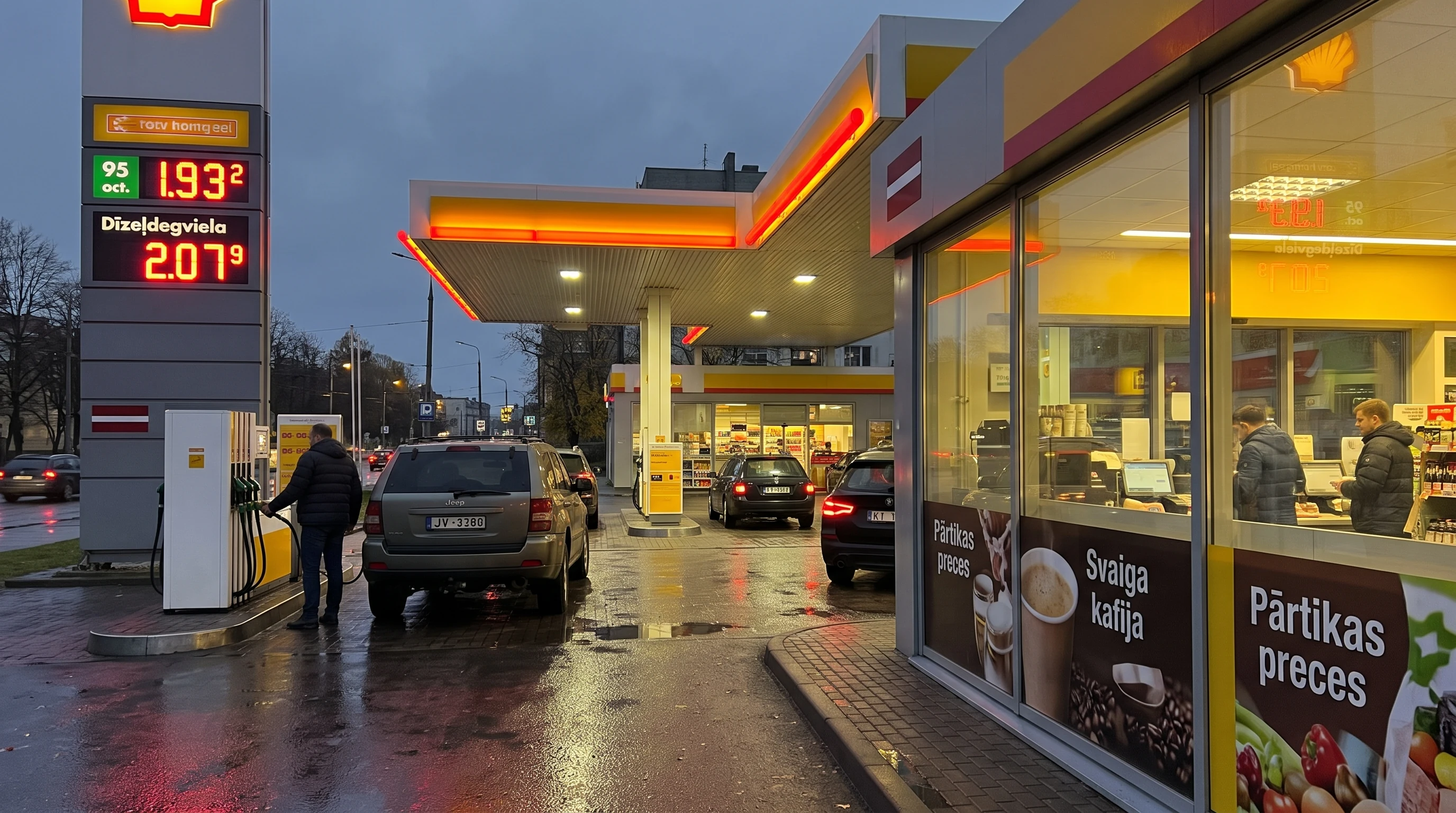
According to Ministry of Finance data published on November 11, average monthly fuel prices in October barely budged compared to September. Diesel averaged €2.079 per liter at Latvian filling stations in October (a staggering 38.1% jump year-on-year), while 95-octane petrol averaged €1.932 per liter (up 27.9% over the past year).
Looking at the week-by-week breakdown tracked by the Finance Ministry, the market did react during the first week of October, though in a deeply lopsided way:
- 95-octane petrol dropped by an average of 7.5 cents per liter — meaning nearly the entire tax cut made it onto gas station signboards;
- diesel (the very fuel the bill was designed to target in order to support hauliers and the broader economy) dipped by a mere 1.2 cents per liter — less than one-sixth of the theoretical maximum.
By the second week of October, global crude prices were climbing again, fueled by ongoing military confrontation in the Persian Gulf and shipping disruptions in the Strait of Hormuz. Global market pressures quickly wiped out even that brief dip at the pump. Yet for the state treasury, the three-month tax holiday comes with a very real price tag: the shortfall to the central government budget is estimated at €14.4 million (€9.6 million hitting 2026 cash flows, and another €4.8 million spilling into early 2027).
Why the Grocery VAT Cut Delivered a Different Outcome
Set against the fuel experiment, the government’s second tax intervention tells a completely different story. From July 1, 2026 through June 30, 2027, Latvia is applying a reduced 12% VAT rate (down from the standard 21%) to four staple food categories: all types of bread, fresh milk, chilled poultry, and eggs.
Purely by the numbers, cutting VAT from 21% to 12% should lower shelf prices by 7.44% if fully passed on to shoppers. However, figures from the Central Statistical Bureau (Centrālā statistikas pārvalde, CSP) and price monitoring by the Consumer Rights Protection Centre (Patērētāju tiesību aizsardzības centrs, PTAC) show that retail prices across those four categories actually fell further than the math alone would suggest.
According to monitoring results published by the PTAC, prices across the four targeted food groups dropped by an average of 10.18% between June 1 and September 1. Bread fell by 9.01%, milk by 10.8%, poultry by 8.89%, and eggs by 12.03%.
By the end of October, the Ministry of Finance reported that overall food prices in Latvia were down 5.4% year-on-year (following a 4.8% annual drop in September). Importantly, broader food deflation had already started back in April—months before the VAT cut took effect—and spanned almost every grocery aisle. Crediting the entire drop in food prices to the tax break alone would therefore miss the bigger picture.
Even so, falling grocery bills shaved 1.1 percentage points off headline annual inflation, keeping Latvia’s October consumer price growth at 3.1% (as noted by the Ministry of Economics, average inflation for full-year 2026 is also projected to hover just above 3%), whereas preliminary estimates show average eurozone inflation accelerating to 4.0% in October.
The stark contrast between groceries and fuel comes down largely to how the two markets are structured and policed:
- Shelf transparency and supermarket competition. Shoppers can easily compare old and new price tags on a loaf of bread or a carton of milk at their local store, while targeted food items are closely tracked under a state monitoring program involving the CSP, the PTAC, and the Competition Council. Supermarket chains also seized on the VAT cut as a marketing hook to wage price wars, which spilled over into neighboring product categories.
- Commodity-linked fuel pricing. Retail diesel prices are tethered to daily global oil product quotes and currency exchange rates. When wholesale costs shift every single day, it is virtually impossible for an ordinary driver looking at a gas station pylon to separate a 6.6-cent tax cut from global market swings or shifting retail margins. On top of that, Europe continues to face tight refining capacity and supply constraints for diesel, keeping wholesale premiums stiffer than those for petrol.
What Changes for Drivers and Shoppers on January 1, 2027
For household budgets and small businesses alike, the biggest takeaway from the October numbers isn't about what happened last month—it's about what looms over the next eight weeks.
The Ministry of Finance expects annual inflation in Latvia to hold near 3% in November before picking up steam in December. Then, as 2026 turns into 2027, two major pressures are set to collide:
- Full fuel excise rates return on January 1, 2027. The current tax relief under the Law on Limiting the Increase in Prices of Petroleum Products carries a hard expiration date of December 31, 2026. Unless the incoming government currently taking shape in coalition talks—or the newly elected 15th Saeima—steps in with fresh legislation to extend the relief, diesel excise duty will automatically jump from €330 to €467 per 1,000 liters on New Year's Day, while petrol duty will rise from €490 to €555. Crucially, the €396 diesel rate in place prior to October was itself a temporary discount. If the full tax increase is passed on to drivers and all other cost factors remain equal, that translates to a potential pump price hike of roughly 16.6 cents per liter for diesel and 7.9 cents for petrol, including VAT. What drivers actually end up paying at the station will also depend on global oil quotes, wholesale procurement costs, and retail markups.
- A reversal in food prices. In September, farm-gate and producer prices among Latvian food manufacturers were already creeping back up (+0.6% compared to August), while the UN Food and Agriculture Organization (FAO) global food price index rose 5.9% year-on-year. The Finance Ministry has warned bluntly that Latvia is unlikely to escape renewed food inflation in 2027—and the temporary 12% VAT rate on bread, milk, poultry, and eggs is slated to expire on June 30, 2027.
If your business or daily commute relies heavily on fuel—from courier deliveries and regional freight to driving in from the suburbs—it makes sense to budget for the tax component of diesel rising by around 16.6 cents per liter (and petrol by 7.9 cents) in the first quarter of 2027. While that doesn't guarantee an identical jump on the station signboard, it represents a very real cost risk if lawmakers let the autumn tax relief expire.
#Latvia #Latvija #Economy #FuelPrices #Inflation #Taxes #Saeima #ViktorsValainis